Food shopping in Czechia can be a confusing experience for first-time visitors and new expats. While many products look familiar on the shelves, the labels are written in a way that makes even simple staples like bread, flour hard to recognize if you do not know the local terminology.
Looking for Milk, Cream, or Baking Cheese? The Czech dairy aisle is notoriously tricky for expats. Because terms like Smetana can mean three completely different things, we wrote an entire standalone guide to help you find exactly what you need. Check out our comprehensive Czech Dairy & Cream Labels Guide to avoid ruining your morning coffee or evening pasta.
🛑 Common Confusing Foods in Czech Shops
Some products in Czech shops are notorious for being “traps” for newcomers. Even if you recognize the pictures on the packaging, the technical differences in how these items are processed can lead to cooking mistakes. Before we get into the full product lists, let’s tackle the specific labels that cause the most confusion in the kitchen.
Food packaging tells you about the product, but shelf prices and shopping procedures are a separate topic. See my guide to Czech supermarket rules for help with loyalty discounts, produce scales, checkout, and bottle returns.
🍪Czech Flour Types (Mouka Explained)
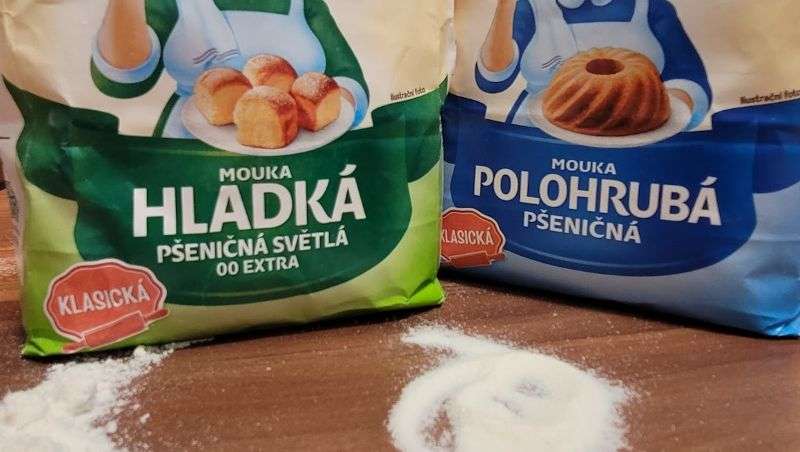
In many countries, you buy flour by purpose (like “plain” or “self-raising”). In the Czech Republic, flour is categorized by how finely the grain is ground:
- Hladká mouka (Fine / Smooth): Best for pancakes (palačinky), thickening sauces, and cakes.
- Polohrubá mouka (Semi-coarse): The closest to all-purpose flour. Used for traditional Czech sponge cakes (bublanina).
- Hrubá mouka (Coarse): Best for boiling. Use this for Czech dumplings (knedlíky) or pasta.
- Note: Self-raising flour does not exist here. You must buy Kypřicí prášek (baking powder) separately.
🧈 Butter vs Yeast in Czech Shops (Máslo vs Droždí)
Newcomers often mistake fresh yeast for a small portion of butter. Both are sold in the dairy fridge and look similar.
- Máslo (Butter): Sold in large 200g to 250g blocks. Small individual portions are rare.
- Droždí (Yeast): Sold in small 42g cubes wrapped in silver or gold foil.
✅Tip: If it’s 42g and wrapped in foil → it’s probably yeast, not butter.
Bread and Pastries (Pečivo)
Bread plays an important role in the Czech diet, but the style is often darker, denser, and heavier than typical Western European white bread.
Czech bread is often darker and heavier than Western bread, but white bread rolls are eaten daily.
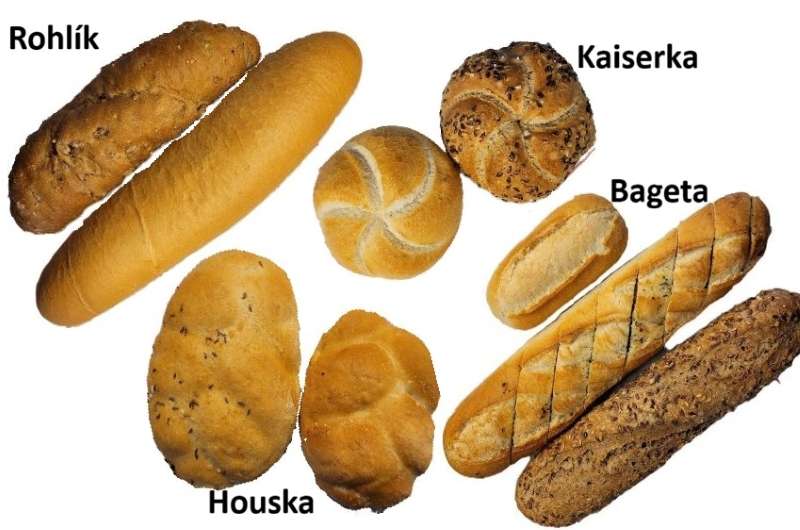
- Rohlík: The most common Czech bread roll. It is long, white, soft, and very cheap. Locals eat them plain or for sandwiches.
- Houska & Kaiserka: Round bread rolls. They are firmer than a rohlík and often have poppy or sesame seeds on top.
Other pastries
- Bageta (baguette) – A longer type of white bread, similar to a French baguette. You can also find versions made with whole grains or seeds.
- Koláč, šátek – Sweet pastries filled with fruit, poppy seeds, or soft cheese (tvaroh). These are popular as snacks or for breakfast.
Before you grab your bags, make sure to check the calendar. Czechia has specific laws that force large supermarkets to close on certain dates. See our full list of Czech Public Holidays and Shop Closures so you don’t end up standing in front of a locked door!
🥩 Meat and Poultry (Maso)
Meat labels in Czechia show the animal type and often the cut. Look for these main words:
- Kuřecí maso: Chicken.
- Vepřové maso: Pork.
- Hovězí maso: Beef.
- Krůtí maso: Turkey.
- Mleté maso: Minced (ground) meat. It is often a mix of pork and beef (Vepřové + Hovězí). Check the label for the percentage of meat vs. fat.
- Šunka (Ham): Look at the quality class (jakostní třída).
- Nejvyšší jakost means the highest quality with the most real meat.
- Standardní is the lowest quality.

If you want to see which store has the best sales this week, locals use the Kupi.cz website to compare prices across all major chains.
🥤 Drinks and Beverages (Nápoje)
💧 Water (Voda)
Bottled water is divided by how bubbly it is. The bottle caps usually follow a color system, but always read the text:
- Neperlivá (often Light Blue cap): Still water (no bubbles).
- Jemně perlivá (often Green or Blue cap): Mildly sparkling (light bubbles).
- Perlivá (often Dark Blue or Red cap): Fully sparkling (heavy bubbles).
- Ochucená: Flavored water (usually contains sugar or sweeteners).
🍺 Beer (Pivo)
Czech beer labels use degrees (like 10°, 11°, or 12°) instead of just alcohol percentage.
- The Degrees (°): This is the Balling scale. It shows how much sugar was in the beer before fermentation. Higher degrees mean a stronger, richer flavor and more alcohol.
- 10° (Výčepní): Light, easy to drink, around 4% alcohol.
- 12° (Ležák): Traditional premium lager, around 5% alcohol.
- Světlé: Light/blonde beer.
- Tmavé / Černé: Dark or black beer (sweeter flavor).
- Řezané: A mix of light and dark beer.
🧂 Other Grocery Staples
🥚 Eggs (Vejce)
Eggs are sold in boxes of 6, 10, or 30. They are sized like clothes: S, M, L, XL. If you care about how the chickens live, look at the first number stamped directly on the eggshell inside the box:
- 0: Organic (Bio).
- 1: Free-range (Chov ve výběhu).
- 2: Indoor barn (Chov v hale).
- 3: Caged (Chov v klecích).
🛢️ Cooking Oil (Olej)
- Slunečnicový olej: Sunflower oil. Best for general cooking and baking.
- Řepkový olej: Rapeseed (canola) oil. Great for frying because it handles high heat well.
- Olivový olej: Olive oil. Look for Extra panenský for extra virgin.
🍚 Rice, Pasta, and Sugar
- Rýže: Rice. Varné sáčky means the rice comes in plastic boiling bags inside the box.
- Těstoviny: Pasta.
- Sůl: Salt.
- Cukr: Sugar. Krupice is standard granulated sugar, Krystal is coarse sugar, and Moučka is powdered/icing sugar.
💡 Ready to head to the store? Knowing the labels is only half the battle. To avoid getting stressed at the register or confused in the aisles, check out our quick guide on “How to Navigate Czech Supermarkets” for the unwritten rules about shopping carts, weighing veggies, and checkout etiquette.
Learning these basic Czech food names will help you avoid the most common kitchen mistakes and shop with confidence!
If you are wondering about the best payment methods, check out our guide on How to Pay in Czech Shops (2026): Cash vs. Card. While cards are accepted almost everywhere, there are a few tips you should know before you tap.
❓ FAQ – Food Shopping in Czechia
What is the difference between a rohlík and a houska?
A rohlík is long, finger-shaped, and has a smooth, simple crust. A houska is rounder, often braided from multiple strands of dough, and frequently topped with poppy seeds or sea salt.
What is “Kofola” in the drink aisle?
Kofola is a highly popular Czech herbal cola. It is slightly less sweet than Coca-Cola, contains a blend of 14 herbal ingredients, and has a distinct, slightly medicinal taste.
How do I read expiration dates on Czech food labels?
Look for two specific phrases:
- Minimální trvanlivost do: Means “Best before.” Found on dry goods like rice or pasta. It is safe to eat after this date, but the quality might drop.
- Spotřebujte do: Means “Use by.” Found on fresh food like meat or dairy. Do not eat it after this date.
What do the price tag abbreviations mean?
Prices are not always per kilogram. Look closely at the letters on the tag:
- 100 g: Price per 100 grams (common for spices, cheese, and nuts).
- 1 kg: Price per kilogram.
- 1 ks (kus): Price per single piece (like one cucumber or lettuce).
Where can I find liquid chicken or beef broth?
Large cartons of liquid stock are rare in Czech stores. Look for small glass jars or pouches labeled Vývar (e.g., Kuřecí vývar for chicken, Hovězí vývar for beef). They are usually near the soup packets or organic foods.
Where is baking soda hiding?
It is not sold in large boxes. Look for tiny paper packets in the baking aisle labeled Jedlá soda. Do not confuse it with Kypřicí prášek, which is baking powder.
Why is Czech brown sugar so dry?
Standard Třtinový cukr (cane sugar) has dry, hard crystals. If you need the moist, packed dark brown sugar used for chewy cookies, look for a package labeled Měkký hnědý cukr (soft brown sugar).
How do I avoid buying parsley instead of cilantro?
They look identical on the shelf. Always check the text on the plastic wrapper: Koriandr is cilantro/coriander, while Petržel is parsley.
🔔Tip: If the supermarket is out of fresh coriander, check a local Vietnamese Večerka convenience store—they always have it.