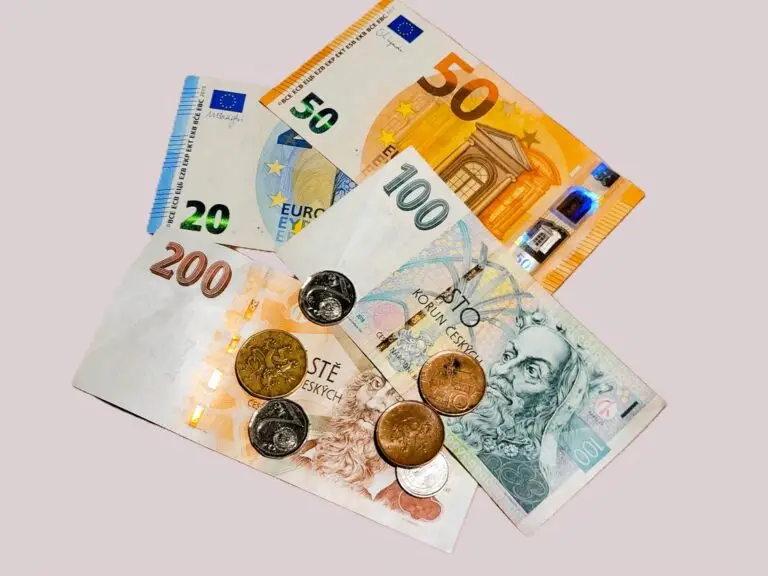
Learning how to pay in Czech shops is simple: cards and mobile payments are widely accepted in Prague, but some cash is useful for smaller shops, cafes, and public toilets. This guide explains when you can pay by card, why to choose Czech crowns (CZK), whether supermarkets accept euros, and what to do if your card payment doesn’t work. It also covers ATM fees and useful Czech phrases for paying.
Paying by Card: Choose CZK When Asked
When you pay with a card or phone, the terminal may ask whether you want to pay in Czech crowns (CZK) or your home currency, such as EUR, USD, or GBP. This question will not appear for every payment. Choose CZK. Here is what the options mean:
- Your home currency: The payment terminal’s provider converts the amount for you. This is called dynamic currency conversion (DCC), and the exchange rate is usually less favorable.
- CZK: You pay in the local currency. If your card account uses another currency, the conversion follows your card issuer’s rules. Its exchange rate and any foreign transaction fees still apply.
You do not need a Czech bank account or a card loaded with Czech crowns. A foreign card can handle the conversion automatically.
What to Check Before You Pay
Check the amount and currency on the terminal before approving the payment, whether you are in a restaurant, a small shop, or a supermarket. If the terminal offers a currency choice, select CZK. If the amount is already shown in your home currency, ask the cashier to restart the payment in Czech crowns.
Choosing CZK avoids the terminal’s currency conversion; it does not necessarily make the payment free of bank fees.
What If Your Card Payment Doesn’t Work?
If tapping your card doesn’t work, try these steps:
- Insert your card into the machine. Follow the instructions on the screen and enter your PIN if asked.
- Check your banking app. It may tell you why the payment failed. Check that you have enough money, haven’t reached your payment limit, and haven’t locked your card.
- Try another card or pay with cash. If the shop’s card machine isn’t working, you may need to pay in Czech crowns.
If your card still doesn’t work, contact your bank.
Check for “Cash Only” Signs Before Ordering
Some restaurants, bars, cafes, and small shops accept cash only, including in central Prague. Look for a “Cash Only” or “Pouze hotovost” sign, and check before ordering or using a service. If you are unsure, ask “Můžu platit kartou?” — “Can I pay by card?”
Keep a small amount of Czech crowns as a backup. If staff direct you to a nearby ATM, check any withdrawal fee and currency-conversion offer before confirming. You can cancel and look for another ATM if the terms are unfavorable.
Paying with Cash: Why Your Total Is Rounded
Prices in Czech shops can include decimals, such as 7.90 CZK, but the smallest coin in use is 1 Kč. When you pay with cash, the final total for your whole purchase is rounded to the nearest crown:
- A total of 47.90 CZK becomes 48 CZK.
- A total of 47.40 CZK becomes 47 CZK.
- A total of 47.50 CZK becomes 48 CZK.
Rounding applies to the final total, not to each item separately. If you pay by card, the exact amount is charged without this cash rounding.
Paying in Czech Supermarkets
Major supermarket chains, including Albert, Billa, Tesco, Lidl, and Penny, accept card payments. You can also use Apple Pay or Google Pay with a supported card.
A few practical details can make checkout easier:
- Keep a backup payment method. A physical card is useful if your phone runs out of battery or mobile payment fails. Some cash can help if card payments are temporarily unavailable.
- Check the self-checkout payment options before scanning. Some machines accept cards only, while others also accept cash. Look for the payment symbols or ask a staff member.
- Keep your receipt until you leave. Some supermarkets have exit gates that open when you scan the barcode on your receipt.
Can You Pay with Euros in Czech Supermarkets?
Some supermarket chains accept euro banknotes, but the rules depend on the store. Check which banknotes are accepted and the exchange rate before paying.
Paying in euros may be convenient if you already have them, but compare the store’s rate before deciding. You can also pay by card in CZK.
For help choosing where to shop, see our guide to Supermarkets in Czech Republic
Paying in Small Grocery Shops: Potraviny and Večerka
Small grocery shops often have Potraviny (“groceries”) or Večerka (“convenience store”) on their signs.
- Check whether cards are accepted. Payment options vary, and some shops may display a minimum amount for card payments. Check before shopping.
- Ask if you are unsure. Say “Můžu platit kartou?” — “Can I pay by card?”
- Ask before splitting a payment. Some shops allow you to pay part in cash and the rest by card. If the cashier agrees, “Zbytek kartou, prosím” means “The rest by card, please.”
Can You Pay Small Amounts by Card?
You can often pay by card for a small purchase, such as a bottle of water or a snack. A low price does not automatically mean you need cash. However, some small shops may display a minimum amount for card payments. Check any signs at the checkout, or ask before shopping.
Paying in Restaurants and Cafes: Can You Tip by Card?
Before ordering, check that you can pay by card. If you want to leave a tip, ask if you can pay it by card too. Tell the waiter how much you want to pay before tapping your card. For example, if the bill is 460 CZK and you want to leave a 40 CZK tip, say “500, please.”
Some card machines let you choose a tip on the screen. Check the total before paying so you don’t add the tip twice. If you can’t tip by card, you can leave the tip in Czech crowns.
For more tips on ordering food, paying the bill, and tipping, see our guide to Czech restaurant etiquette.
Paying for Public Transport and Public Toilets
You can buy Prague public transport tickets without cash, but coins are still useful for some public toilets.
- PID Lítačka app: Buy and activate your ticket in the official app before traveling. Standard short-term tickets cost less in the app than their paper equivalents.
- Ticket terminals on Prague trams and city buses: You can pay with a contactless card, phone, or watch. For more details, see our guide to Prague public transport tickets.
- Public toilets: Payment options vary. Some accept cards, while others require cash, so keep a few Czech coins handy. Our guide to public toilets in Prague explains where to find them.
Withdrawing Cash in Prague: Check Fees and Currency Conversion
If you need Czech crowns, look for an ATM operated by a bank, ideally at a bank branch. However, bank ATMs can also charge fees for foreign cards, so check the screen before confirming.

There are three possible costs:
- The ATM operator’s withdrawal fee: If a fee is displayed and you do not want to pay it, cancel the withdrawal and try another ATM.
- Currency conversion: If offered a choice, select CZK or “without conversion.” This avoids the ATM’s conversion rate and leaves conversion to your card issuer.
- Your own card issuer’s charges: Your bank may charge for withdrawing cash abroad or converting currencies. These charges may not appear on the ATM screen.
Declining currency conversion does not cancel the ATM’s withdrawal fee. Check both before proceeding.
If you brought foreign banknotes, see our guide to exchanging money in Prague for help comparing exchange offices and rates.
Do Czech Shops Accept American Express?
Some businesses accept American Express, but you should check before relying on it. A shop accepting cards does not necessarily accept every card network. Look for the Amex logo or ask before ordering or shopping. Carry Visa or Mastercard, or some Czech crowns, as a backup.
Acceptance also varies between websites and apps. For example, České dráhy accepts American Express for online ticket purchases.
Paying in Prague: Quick Checklist
- Choose CZK when asked. Check the amount and currency before approving a card payment.
- Keep a backup payment method. A physical card helps if your phone runs out of battery; cash helps if card payments are unavailable.
- Carry some Czech crowns. Around 200–500 CZK in smaller notes and coins can be a useful backup if you mainly pay by card. Carry more if you plan to visit cash-only businesses.
- Ask before ordering. “Můžu platit kartou?” means “Can I pay by card?”
- Check ATM fees. Declining currency conversion does not remove a separate withdrawal fee or your own bank’s charges.
- Keep your supermarket receipt. You may need its barcode to open an exit gate.