You can buy groceries in Prague at supermarkets, small convenience stores, farmers’ markets, and specialty food shops. The best option depends on what you need, your budget, and when you’re shopping.
This guide shows you where to find supermarkets in Prague’s city center, budget-friendly options such as Lidl and Penny, and local shops for late-night essentials. It also explains how to find stores near your accommodation, check opening hours, and recognize the Czech signs potraviny and večerka.
On this page
Grocery stores in Prague city center
Where to buy cheap groceries
Late-night and public holiday shopping
Online grocery delivery
Farmers’ markets
Specialty food shops
⚡ Quick Guide: Where to Buy Groceries in Prague
If you’re not sure where to shop, here’s a quick guide:
| What You Need | Best Option |
|---|---|
| Regular or weekly shopping | Supermarket or hypermarket |
| Lower prices | Lidl, Penny, Kaufland, or current supermarket promotions |
| Late-night or holiday shopping | Potraviny or večerka |
| Fresh local products | Farmers’ market |
| Special or imported products | Large supermarket or specialty shop |
| Shopping without carrying bags | Online grocery delivery |
How to Find a Grocery Store Near You in Prague
The easiest way to find a nearby grocery store is to use Mapy.com. Allow the website or app to use your location, then search for supermarket, potraviny, or večerka.

Searching for supermarket will mainly show larger chains. The Czech words potraviny and večerka will also help you find smaller local shops that may stay open later. In my experience, Mapy.com usually has more up-to-date information about Czech shops than Google Maps.
Check the listed opening hours before going, especially on a public holiday. For information about days when large stores must close, see Czech Public Holidays: A Guide to Shop Closures.
Grocery Stores in Prague City Center
You don’t need to leave the center to buy groceries. These supermarkets are convenient if you’re staying nearby or want to pick up food while sightseeing:
| Store | Where to find it |
|---|---|
| Lidl on Na Příkopě | At Na Příkopě 14, close to the lower end of Wenceslas Square. |
| Albert at Můstek — near Bershka | In the underground metro entrance area at the lower end of Wenceslas Square, near Bershka. |
| Albert at Můstek — near Marks & Spencer | In the underground metro hall accessible from the entrance near Marks & Spencer, farther up Wenceslas Square. |
| Albert at Muzeum | In the underground metro entrance hall at the upper end of Wenceslas Square, near the National Museum. |
| Albert in Palladium | On floor −2 of the shopping center at náměstí Republiky. |
| Tesco at Máj Národní | At Národní 26, near the Národní třída metro station. |
| Lidl on Na Poříčí | At Na Poříčí 23, near Bílá labuť. |
| Penny on Revoluční | At Revoluční 7, close to náměstí Republiky. |
The Albert stores at Můstek and Muzeum are below street level, so look for the metro entrance rather than a supermarket storefront. You can reach the shops without entering the paid metro area.
Check the opening hours of the individual store before going, especially on public holidays. For more locations, see the map of supermarkets in Prague city center in my guide to Czech supermarkets.
Where to Buy Cheap Groceries in Prague
For budget grocery shopping in Prague, Lidl and Penny are useful places to start. Lidl is a good option for everyday basics and private-label products. Penny also focuses on affordable groceries, with a smaller selection and a strong emphasis on Czech products and local suppliers.
Kaufland is worth checking for a larger shopping trip, especially if you want more choice. However, compare individual products and current offers—no supermarket is always the cheapest for everything.
A few simple habits can help you spend less:
- Check weekly offers: Look for a supermarket’s leták (promotional flyer), or compare offers on Kupi.cz.
- Read discount labels carefully: Some special prices require a loyalty card or app.
- Compare unit prices: The price per kilogram or liter helps you compare different package sizes.
- Use convenience stores for small purchases: Potraviny and večerka are handy, but usually cost more than supermarkets.
For a fuller comparison, see my guide to supermarkets in the Czech Republic.
Regular Grocery Shopping in Prague
For regular grocery shopping, most people use supermarkets or hypermarkets. They usually offer the best mix of price, choice, and convenience. Supermarkets are common across Prague and are suitable for everyday shopping. The main chains include Albert, Lidl, Kaufland, Tesco, Billa, Penny, and Globus.
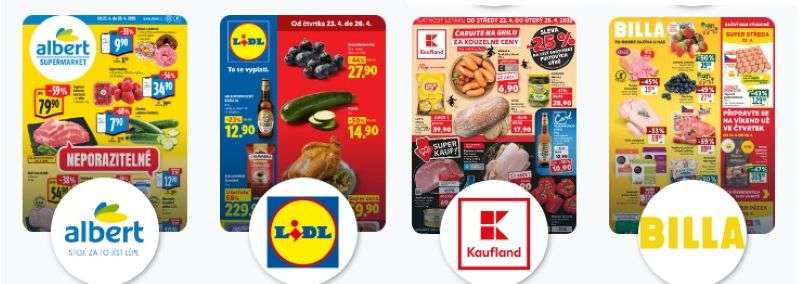
Hypermarkets are much larger and are often located in shopping centers or outside the city center. They are a good choice for weekly shopping because you can buy food, household products, and other items in one place. Discount-focused chains such as Lidl, Penny, and Kaufland are often good choices for basic products and lower prices.
First time shopping in a Czech supermarket? Read our guide to Czech supermarket rules to learn how shopping carts, produce scales, loyalty prices, bags, and self-checkouts work.
Where to Buy Groceries Late at Night or on Public Holidays
In Prague, most supermarkets are open 7 days a week, so regular shopping is usually easy. However, some public holidays are exceptions when large stores stay closed. You can check this guide: Czech Public Holidays: A Guide to Shop Closures.
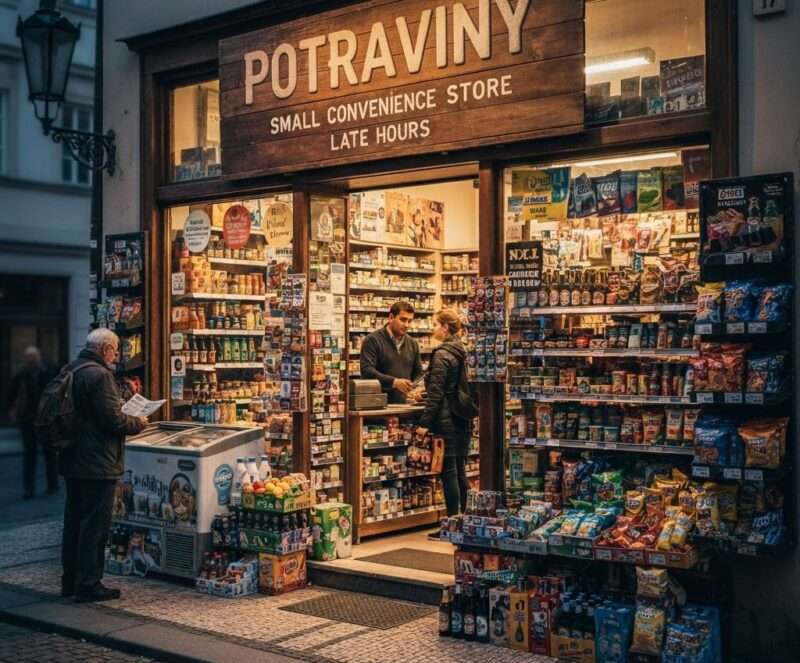
Convenience stores: Večerka & Potraviny
Small grocery shops are common across Prague and are useful when you need a few essentials or nearby supermarkets are closed. Many are run by Vietnamese families.
Potraviny means “groceries” or “food,” while večerka usually refers to a convenience store that stays open into the evening. Opening hours vary, but some shops open early, close late, or stay open on public holidays.
You can usually buy snacks, drinks, bread, milk, and other basics. The main advantage is convenience, although prices are generally higher and the selection is smaller than in supermarkets. They are a practical choice for a quick purchase rather than a large grocery trip.
Online Grocery Shopping in Prague
You can also buy groceries in Prague online and have them delivered to your accommodation. This is useful if you want to save time, compare products, or avoid carrying heavy bags.
Main Online Supermarkets
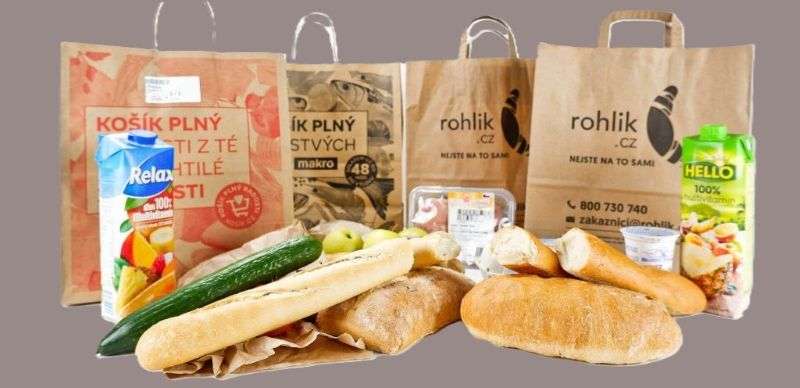
Rohlik.cz, Košík.cz, and Tesco offer online grocery shopping with home delivery. You can order everyday groceries, household essentials, and products for special diets.
Enter your delivery address first to check availability, delivery times, and fees. Some supermarket chains are also available through delivery partners, depending on your location.
Fast Delivery Through Apps
Apps such as Wolt, foodora, and Bolt Food also offer grocery delivery from participating stores. They can be convenient when you need a few items quickly, although the selection may be smaller and the total cost higher than a scheduled supermarket order.
💡 Tip: Before ordering, check the minimum order, delivery fee, and expected arrival time. If you’re staying at a hotel, ask whether it can accept your delivery or arrange to meet the courier yourself.
Need help understanding Czech product names? See my guide to Czech food labels and supermarket products.
Farmers’ Markets in Prague
Prague’s farmers’ markets sell seasonal fruit, vegetables, cheese, honey, and baked goods. They are a good place to explore Czech food and buy from local producers. Prices vary, so don’t expect everything to be cheaper—or better quality—than in a supermarket.

Besides the well-known weekend markets, smaller neighborhood markets can be useful for shopping during the week.
Farmers’ Markets by Day
These are some options for each day, rather than a complete schedule:
- Monday: Holešovice Market Hall (Prague 7), Sluneční náměstí (Prague 13)
- Tuesday: Kubánské náměstí (Prague 10)
- Wednesday: Arkády Pankrác (Prague 4)
- Thursday: Arkády Pankrác, Tylovo náměstí (Prague 2)
- Friday: Anděl (Prague 5)
- Saturday: Kulaťák (Prague 6), Náplavka (Prague 2)
Some markets operate on several days, and schedules can change with the season. Check the current opening days and hours before visiting.
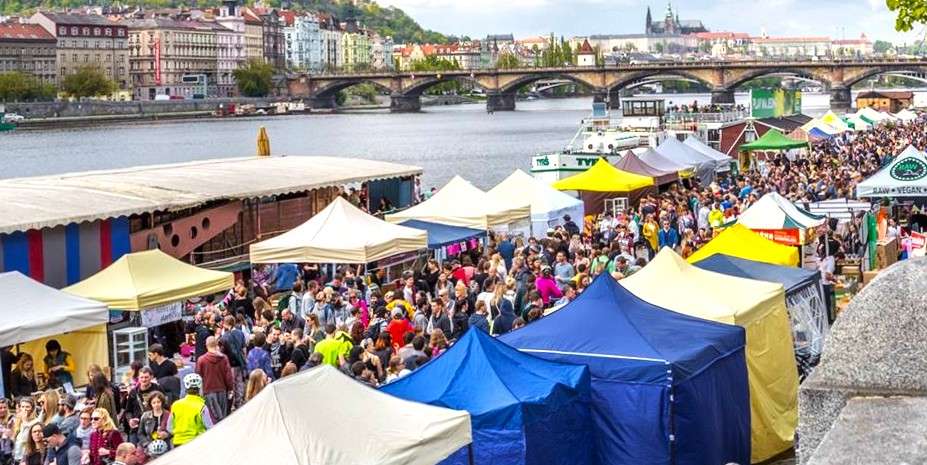
Náplavka: Food Shopping and a Weekend Outing
Náplavka’s Saturday market combines grocery shopping with a walk along the Vltava. Alongside produce and other food to take home, you’ll find stalls selling food and drinks to enjoy there. It is a useful stop for shopping, but also a pleasant place to spend part of your Saturday morning.
Specialty Food Shops
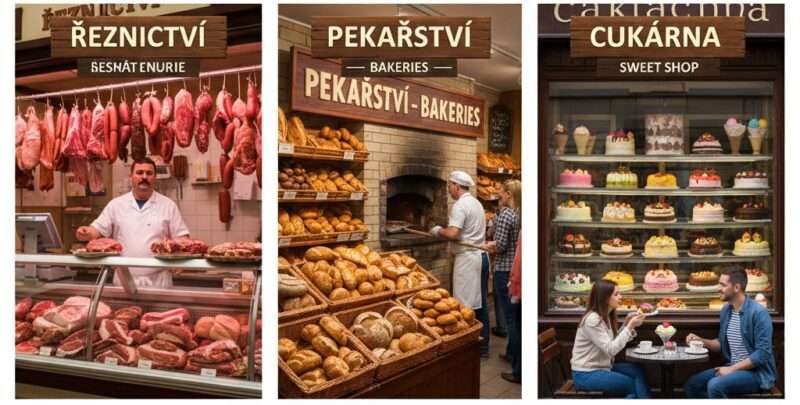
Prague also has shops specializing in meat, fish, bread, and desserts. They are useful if you want a particular product, a wider choice in one category, or help choosing what to buy.
- 🥩 Řeznictví — butcher shops sell meat, sausages, and other meat products. They can be a good option when you need a specific cut or want advice on preparation.
- 🐟 Rybárny — fish shops sell fresh or frozen fish and seafood. The selection varies, so check what is available if you’re looking for something specific.
- 🥖 Pekárny — bakeries. You’ll find Czech bakery chains and independent bakeries selling bread, rolls, and pastries. They are convenient for picking up breakfast or a snack while exploring the city.
- 🍰 Cukrárny — cake and dessert shops. Cukrárny sell cakes and other desserts, often with coffee and seating. They are a good place for a sweet break; Ovocný Světozor is one well-known example.
Prices and quality vary between shops. Choose them for their particular selection rather than assuming they are always better or more expensive than supermarkets.
Special Diet and Organic Food Options in Prague
If you’re looking for gluten-free, lactose-free, vegan, or organic products, start with a larger supermarket. For specific ingredients or less common brands, specialty food shops are also worth checking.
🛒 Supermarkets
Chains such as Albert, Tesco, Kaufland, and Billa carry products for different dietary needs, including plant-based milk, lactose-free dairy, and gluten-free foods. The selection varies by store.
🏪 Specialty food shops
Look for shops labeled zdravá výživa (“health food”). They often stock organic foods, grains, legumes, and products for special diets.
🔎 Useful Czech words on labels
- Bez lepku — gluten-free
- Bez laktózy — lactose-free
- Veganské / vegan — vegan
- Bio — organic
For more help identifying products, see my guide to Czech food labels.
🍷 Buying Alcohol and Tobacco in Prague
You can buy alcohol and tobacco in most supermarkets and convenience stores. You must be at least 18, and staff may ask to see your ID.
Alcohol is generally available during the store’s regular opening hours. For more choice, look for a vinotéka (wine shop) or a pivotéka (specialty beer shop).
💳 How to Pay for Groceries in Prague
Cards and mobile payments are widely accepted in supermarkets and many smaller shops. At farmers’ markets, payment options vary by stall, so carrying some Czech crowns (CZK) is useful.
Some stores accept euro banknotes, but check the exchange rate before paying. Change is usually given in Czech crowns.
💡 Tip: If the card terminal offers a choice of currencies, select CZK to avoid the terminal’s currency conversion.
For more details, see my guide to paying in Czech shops