Which wins the Train vs. Bus in Czechia debate? One is often faster, the other is cheaper—but picking the wrong one can cost you hours of wasted vacation time. So, you need to decide for every destination by yourself.
📊Train vs Bus vs. Car: Quick Summary
| Your Trip Type | Recommended Mode | Why? |
| Prague ↔ Brno | 🚆 Train | Avoids the D1 highway traffic jams. |
| Day Trip to a City | 🚌 Bus | Cheap, direct, and drops you in the center. |
| Castle Hopping | 🚗 Personal Vehicle | Best for remote spots with few bus links. |
| Long Haul (Ostrava) | 🚆 Train | High-speed, comfortable, and reliable. |
🗺️Popular Route Comparison: Real Times & Prices
On some routes, the train is a comfortable luxury. On others, the bus is a major shortcut. Here is how the most popular journeys compare:
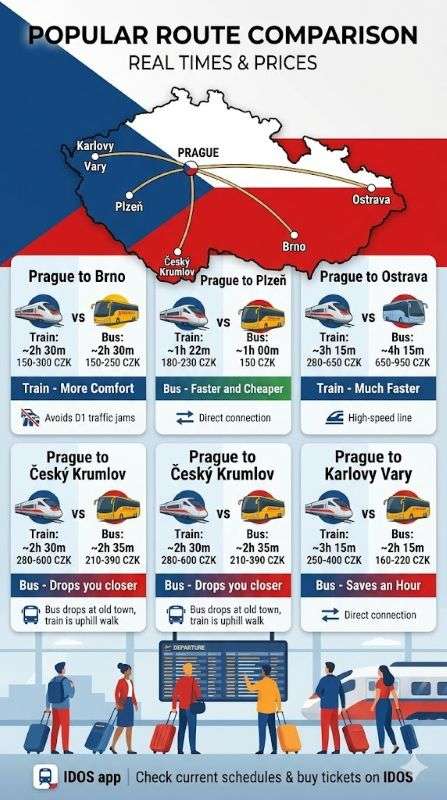
- 🏆 Train: ~2h 30m | 150–300 CZK (Our pick for comfort and avoiding traffic)
- Bus: ~2h 30m | 150–250 CZK
Prague to Plzeň
- Train: ~1h 22m | 180–230 CZK
- 🏆 Bus: ~1h 00m | 150 CZK (Our pick: Faster and cheaper)
Prague to Ostrava
- 🏆 Train: ~3h 15m | 280–650 CZK (Our pick: Much faster)
- Bus: ~4h 15m | 650–950 CZK
- Train: ~2h 30m | 280–600 CZK
- 🏆 Bus: ~2h 35m | 210–390 CZK (Our pick: Drops you right at the town center)
- Train: ~3h 15m | 250–400 CZK
- 🏆 Bus: ~2h 15m | 160–220 CZK (Our pick: Saves an entire hour)
The train vs. bus in Czechia score for popular destinations: Train 2x 🏆 vs. Bus 3x 🏆
How to Decide: When the Bus Wins (and When the Train is Better)
The table above shows the fastest average times, but your actual travel day might be different. To make the best decision for the train vs bus Czech Republic debate, follow these two rules:
1. 📍Check the Actual Station Location
A transport option might look faster on paper, but you need to check where you arrive.
- Train Stations (Nádraží): In Prague, Brno, and Olomouc, the main train stations are in the absolute city center. However, in Český Krumlov, the train station is a 20-minute, steep uphill walk from the old town.
- Bus Stations (Autobusové nádraží): In Karlovy Vary or Plzeň, the bus drops you much closer to the historic sights than the train.
*️⃣ Tip: Always look at the arrival station on a map before buying. A slightly slower bus is better if it drops you right next to your hotel.
2. 🔄 Understand Ticket Flexibility (The Biggest Difference)
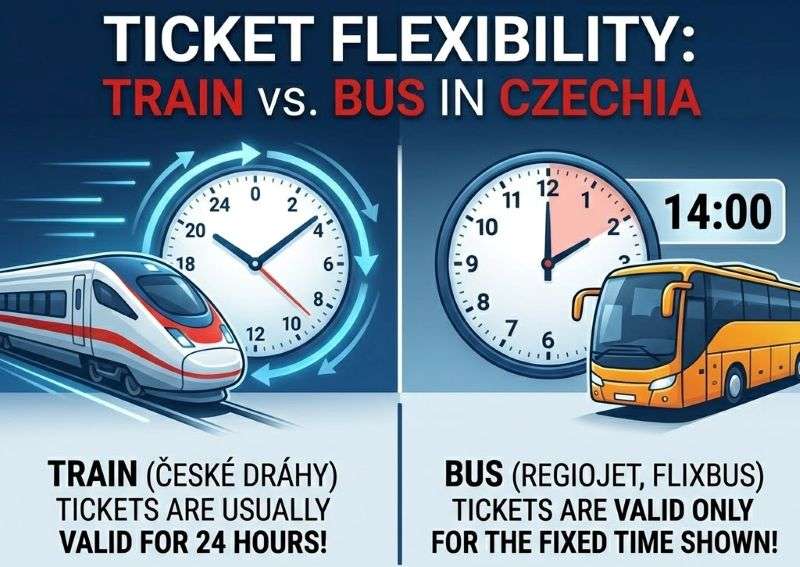
- National Trains (České dráhy): Standard tickets are usually valid for the whole day on that specific route. If you miss your planned train, you can simply hop on the next domestic train. You do not have a fixed seat unless you buy a seat reservation (místenka).
- Buses and Private Trains (RegioJet, Leo Express, FlixBus): These tickets are tied to a specific time and seat. If you miss the departure, your ticket is gone. This requires precise planning, but it guarantees you a seat and often costs less.
3. 💰 The Price Myth: Train vs. Bus Cost
At first glance, buses usually look cheaper than trains. However, this is a myth if you know how to buy national train tickets. The national rail carrier, České dráhy (ČD), offers built-in discounts that can make the train just as cheap as a bus—or even cheaper.
- Group Discounts (Skupinová jízdenka): You do not need a massive tour group to save money. The “group” discount starts with just two people traveling together. The first person pays full price, the second person gets a discount, and every person after that saves even more.
- First-Minute Tickets (Včasná jízdenka): If you book your ČD train ticket online or via their app a few days in advance, the price drops significantly compared to buying it at the station right before departure.
ℹ️ Because of these hidden savings, the actual price difference between a train and a bus on major routes like Prague to Brno or Olomouc is often completely minor.
Before you buy any tickets, read my detailed guide to Czech Train Discounts for Tourists to see exactly how to claim these group savings and first-minute deals on your trip.
4. Consider Comfort and Luggage
- Choose the Train if: You travel with large suitcases, strollers, or active children. You can walk around, use the restroom easily, and many trains have a bistro car for snacks.
- Choose the Bus if: You want a guaranteed seat, free Wi-Fi, and cheap tickets on short routes (like Prague to Liberec). Large luggage goes into the hold under the bus, so you cannot access it during the trip.
📱 How to Find Schedules and Buy Tickets
Do not guess your travel times. Schedules in the Czech Republic can change due to weekends, public holidays, or track maintenance.
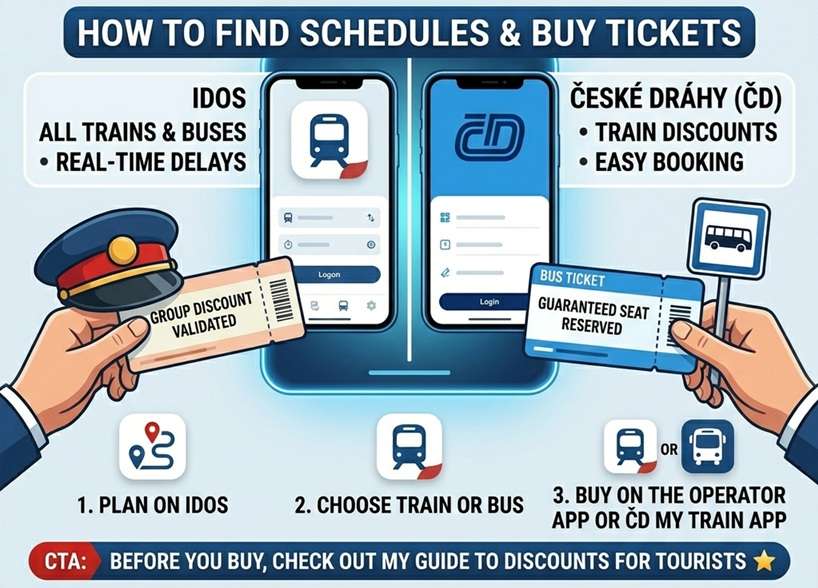
To keep your planning simple, follow this exact 3-step workflow:
- Find the Route: Use the IDOS app or website. It is the official Czech transport planner that combines all trains and buses in one place so you can compare times.
- Check for Discounts: Before you hit buy, make sure you aren’t leaving money on the table (like the ČD group discount for 2+ travelers).
- Buy Directly from the Operator: Once IDOS shows you who operates the trip, buy your ticket directly in the Můj Vlak app (for national trains) or the RegioJet / FlixBus apps (for buses and private lines).
Planning your journey is much simpler with the right tools. Check out my guide to the 35 Best Apps for Tourists in Prague and ČR to download everything you need for route planning, tickets, and parking.
⚠️ Why You Should Avoid the D1 Highway by Bus
The main highway connecting Prague and Brno (the D1) is famous for heavy traffic, frequent roadworks, and sudden accidents.
During peak hours, a standard 2.5-hour drive can turn into a 4-hour delay. While buses are a great option for many cities, always choose the train for the Prague–Brno and Prague–Ostrava routes. Trains run on their own tracks and completely bypass highway traffic jams.
🚗 When a Car is Still the Best Option
Buses and trains are perfect for traveling between cities. However, public transport fails if you want to visit the “deep countryside.”
If your plan involves visiting tiny villages, remote mountain trailheads, or multiple castles in one afternoon, rent a car. Otherwise, you will spend hours waiting at rural bus stops.
For example, less than an hour’s drive from Brno, you can explore three stunning landmarks. Read my guide on Lednice, Valtice, Mikulov: 3 Beautiful Castles in south Moravia to plan a perfect road trip.
If you decide that the rail network fits your style best, read my full How to Use Trains in Czech Republic: Companies, Apps & More

