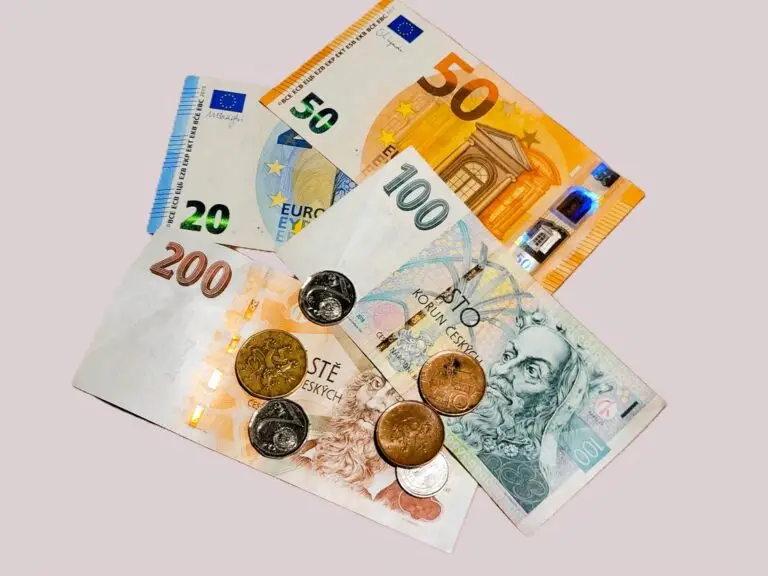
Finding a fair way to exchange money in Prague shouldn’t be a game of luck. With dozens of bureaus competing for your cash, the difference between a great rate and a total scam is often hidden in the fine print. Forget relying on outdated tips; you need to know how to judge a bureau for yourself. This guide provides the essential rules to help you identify a good rate in real-time, in any part of the city.
💰 What Are Your Options for Exchanging Money?
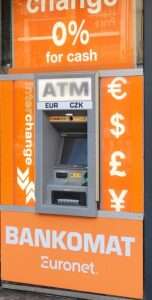
You have four main options, but they are not created equal:
| Option | Safety & Reliability | Pros | Cons / Risks |
| Official Exchange Bureaus | High (If reputable) | Can offer the best place to exchange money in Prague if you check the rates first | You must carefully check the rates and ensure no hidden fees before signing. |
| Banks | 100% Safe | Extremely secure and reliable. | Poorer exchange rates and limited hours (usually closed on weekends). |
| Contactless / ATMs | High (Avoid Euronet) | Using a card is the best, most convenient way to pay. | Predatory rates and high convenience fees if you accidentally use yellow-and-blue Euronet ATMs. |
| Street Changers | 0% Safe (Scam) | None. | NEVER do this. You are guaranteed to receive worthless, out-of-circulation banknotes. |
The 2026 Golden Rule: absolutely never trade cash with individuals on the street.
Choosing an exchange bureau doesn’t mean guessing. To make sure you get a safe, fair rate on the street, use this quick checklist before you hand over any cash.
Quick Checklist Before You Swap Your Cash
If you are going to exchange money, check the live conversion rate first. It is best to do this at your hotel. If you are already in the city and don’t have mobile data, use the free Wi-Fi at public transport stops (for example, walk down into a metro station).
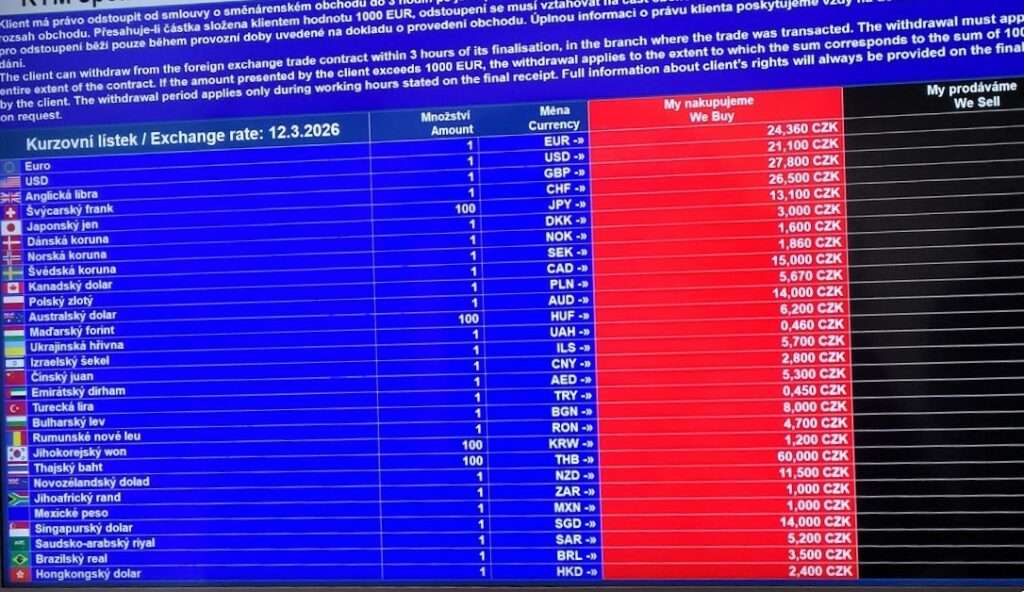
Once at the exchange office, find the official exchange-rate board. It must be clearly visible and provide the required information in both Czech and English. It must also explain your right to cancel the exchange within three hours, as shown in the photo below.
- Look for the “WE BUY” column on the exchange-rate board. The exchange office is buying your foreign currency, so this is the rate that applies to you. In Czech, it may say my nakupujeme.
- Calculate how much you should receive. For example, if the rate is 24.20 CZK for €1, you should receive 2,420 CZK for €100.
- Before handing over your money, ask how much you will receive in total. The teller may show you the amount on a calculator or screen. The office may offer a better rate for a larger total amount, but it cannot give you a worse rate than the one shown on its official board. If the amount is lower than your calculation, do not continue with the exchange.
This flow will help you avoid unfair bureaus with hidden fees. However, you still need to check if the rate itself is actually good
How to Know If an Exchange Rate Is Good
Before exchanging cash, check the current mid-market rate on Google, XE, or the Czech National Bank website. This is a reference rate—you will normally receive slightly less at an exchange office.
Compare this rate with the exchange office’s “We Buy” rate. The closer the two numbers are, the better the offer.
How to Understand if Changing Rate are Good
Imagine that the current reference rate is 24.30 CZK for €1 and the exchange office offers 24.10 CZK. The difference is 0.20 CZK for each euro.
If you exchange €100:
- Reference value: 2,430 CZK
- Amount from the exchange office: 2,410 CZK
- Difference: 20 CZK
This is a small difference and would usually be a fair cash exchange. However, if the office offered only 22 CZK for €1, you would lose 230 CZK when exchanging €100. That would be a very poor rate.
ℹ️ As a practical guide, a rate around 1% below the current reference rate is usually good for cash exchange. A difference of several percent means you should compare another exchange office.
⚖️Your Legal Protection: The 3-Hour Right to Cancel
Many tourists don’t know that Czech law is actually on their side. According to Czech National Bank (CNB) regulations:
- If you are unhappy with an exchange, you can cancel it free of charge and without giving a reason. You must return to the same exchange office within three hours of the transaction.
- This right covers an amount up to the equivalent of €1,000. If you exchanged more, you can cancel only the part equal to €1,000—not the entire transaction.
- The exchange office must give you a receipt. Keep it until you have checked the rate, counted your money, and confirmed that everything is correct. If you need to cancel the exchange, take the receipt and the money you received back to the same office.
Exchange offices cannot add a separate commission when you exchange banknotes. However, a “0% commission” sign does not guarantee a good deal because the office can still use a poor exchange rate.
How to Recognize Invalid Czech Banknotes
Some older Czech banknotes stopped being valid in July 2022. These are 100, 200, 500, 1,000, and 2,000 CZK notes issued between 1995 and 1999.
The easiest way to recognize them is by checking the silver security thread. Invalid banknotes have a thin thread that does not change color when you tilt the note. Valid versions have a wider thread that changes from reddish-purple to green.
The 5,000 CZK banknote is an exception. Both versions remain valid, including the older version with a thin security thread.
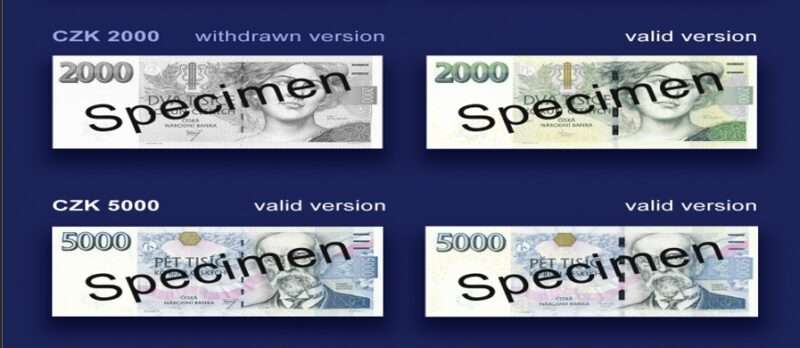
Shops will not accept invalid banknotes. However, you can exchange them free of charge at the Czech National Bank for an unlimited period. In Prague, the CNB cash office is at Na Příkopě 28, Prague 1. Check the current opening hours on the CNB website before visiting.
Make Sure It Is a Czech Banknote
Until you know what Czech money looks like, check every banknote for the words KORUN ČESKÝCH and ČESKÁ NÁRODNÍ BANKA. These words appear on all Czech banknotes, as shown in the image below.
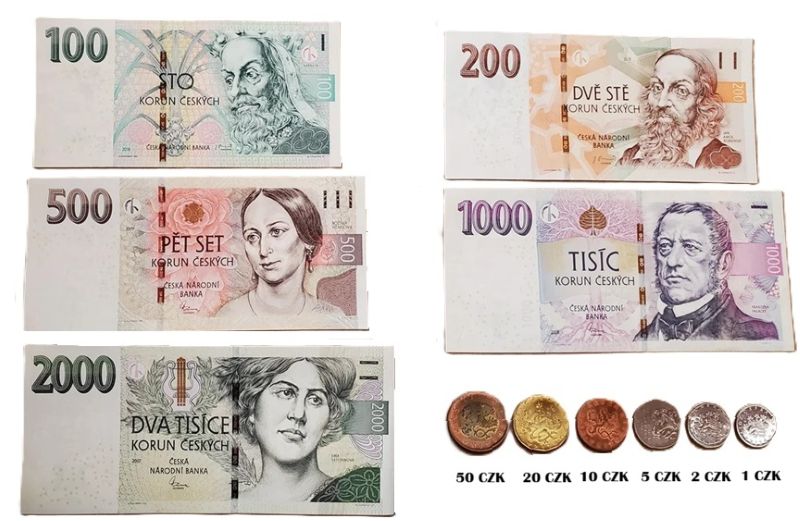
Never exchange money with someone on the street. Also, be careful if a stranger asks you to change a large banknote. They may give you Belarusian rubles or another foreign currency that cannot be used in Czechia. If you are unsure, simply refuse.